
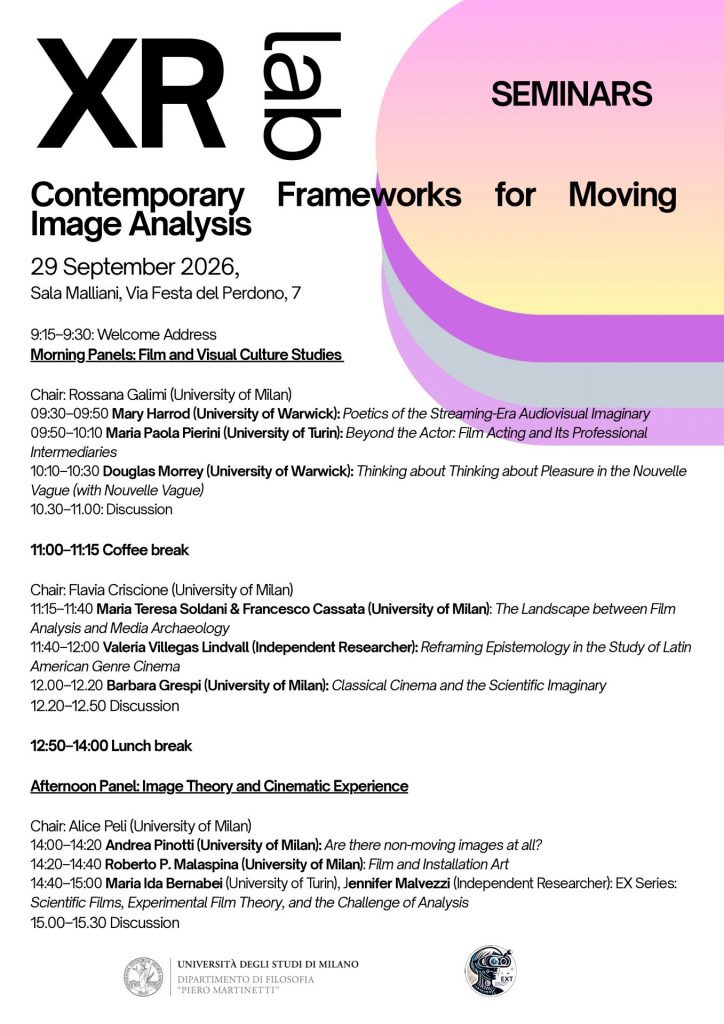
Sala Malliani, Via Festa del Perdono, 7.
A cura di Francesco Cassata, Barbara Grespi e Roberto P. Malaspina
Nel contesto del Centro di Ricerca EXT, l’XRLab è lieto di annunciare la giornata di studi Contemporary Frameworks for Moving Image Analysis, dedicata alle prospettive contemporanee di analisi delle immagini in movimento. L’incontro riunirà studiose e studiosi italiani e internazionali per discutere approcci e metodologie tra film e visual culture studies, teoria dell’immagine, archeologia dei media ed esperienza cinematografica.
Tuesday 29
9:15–9:30: Welcome Address
Morning Panels: Film and Visual Culture Studies
Chair: Rossana Galimi (University of Milan)
09:30–09:50 Mary Harrod: Poetics of the Streaming-Era Audiovisual Imaginary (University of Warwick)
09:50–10:10 Maria Paola Pierini: Beyond the Actor: Film Acting and Its Professional Intermediaries (University of Turin)
10:10–10:30 Douglas Morrey: Thinking about Thinking about Pleasure in the Nouvelle Vague (with Nouvelle Vague) (University of Warwick)
10.30–11.00: Discussion
11:00–11:15 Coffee break
Chair: Flavia Criscione (University of Milan)
11:15–11:40 Maria Teresa Soldani & Francesco Cassata: The Landscape between Film Analysis and Media Archaeology (University of Milan)
11:40–12:00 Valeria Villegas Lindvall: Reframing Epistemology in the Study of Latin American Genre Cinema (Independent Researcher)
12.00–12.20 Barbara Grespi: Classical Cinema and the Scientific Imaginary (University of Milan)
12.20–12.50 Discussion
12:50–14:00 Lunch break
Afternoon Panel: Image Theory and Cinematic Experience
Chair: Alice Peli (University of Milan)
14:00–14:20 Andrea Pinotti: Are there non-moving images at all? (University of Milan)
14:20–14:40 Roberto P. Malaspina: Film and Installation Art (University of Milan)
14:40–15:00 Maria Ida Bernabei (University of Turin), Jennifer Malvezzi (Independent Researcher): EX Series: Scientific Films, Experimental Film Theory, and the Challenge of Analysis
15.00–15.30 Discussion
ABSTRACTS
Mary Harrod (University of Warwick), Poetics of the Streaming-Era Audiovisual Imaginary
Anxiety about new forms of subjectivity and being tailored to the hyper-rationalising architectures of the digital age is apparent in numerous film and television narratives of the video-on-demand era. It is particularly visible in a raft of ‘digistopian’ visions of the present and future, where human life is negatively coloured by digital engagement, peppering streamed fiction of the past decade. In other words, social reckoning with unsettling changes through storytelling in a mainstream vernacular is now mediated by the very channels determining the new order not merely industrially but formally. This paper examines the resulting highly contradictory poetics of the digital media under scrutiny, encompassing both texts’ features and a theorisation of their medium’s role in the social system (Lefevere 1992). After giving an overview of ways in which streamed fiction questions the benefits of techno-capitalism’s injunction for human life to become uncoupled from the corporeal experience of personhood, it will home in on two case studies: the films El Hoyo/The Platform 1 and 2 (Galder Gaztela-Urrutia, Netflix Spain, 2019, 2024) and the series Severance (Apple TV+, 2022-). The aim is to ask whether long-form mass-popular narratives produced within a media-sphere whose dystopian shadow haunts its output might nonetheless provide a valuable means of reimagining human (inter-)subjectivity.
Maria Paola Pierini (University of Turin), Beyond the Actor: Film Acting and Its Professional Intermediaries
Film acting presents a persistent challenge to analysis. Its apparent transparency – the impression that the actor simply “is” the character – often obscures both performance strategies and the processes through which they take shape. Over the past few decades, actor studies have become increasingly dynamic: ontological approaches have sought to define the specificity of the film actor, stylistic approaches have examined the actor’s gestural text, while methodological approaches have addressed training, interpretation, direction, and authorship. This paper brings these perspectives together in an integrated methodological proposal, which I would define as a genetic study of performance.The proposal is to shift attention from the finished performance alone to what precedes it: how a performance is constructed, which expressive choices are explored or abandoned, and who accompanies actors in the process of becoming characters. Developed through research into casting and coaching practices in contemporary Italian cinema, as well as through conversations with teachers, directors, agents, this methodological framework foregrounds the intermediaries who contribute to shaping that transition. It also considers photographs, rehearsal footage, diaries, interviews, and other preparatory traces as possible “avant-textes” of film performance. Bringing together close analysis, the study of intermediaries, and, where possible, participant observation may help reconstruct the origins of expressive choices, clarify the distribution of agency between actors and their collaborators, and provide more precise tools for identifying performance strategies beyond the indeterminacy of the finished image.
Douglas Morrey (University of Warwick), Thinking about Thinking about Pleasure in the Nouvelle Vague (with Nouvelle Vague)
This paper outlines initial ideas for a new research project entitled ‘The French New Wave and the generation of pleasure.’ The project aims to reassess the role of pleasure in French New Wave cinema, both the role and importance of spectatorial pleasures in the criticism that preceded and launched the New Wave, and the role and functions of pleasure in the design and realisation of the films themselves. The project also reflects upon the association of the New Wave movement with the so-called ‘baby boomers,’ a generation that has sometimes been accused of prioritizing its own pleasure, the long-term costs of which we are now beginning to count. With this in mind, the project interrogates certain key areas or markers of pleasure in the work of different New Wave filmmakers and asks how we might be drawn to reevaluate them from our perspective today.
Maria Teresa Soldani & Francesco Cassata (University of Milan), The Landscape between Film Analysis and Media Archaeology
The concept of landscape – widely debated in art history and aesthetics – raises many questions in film analysis. Is landscape a visual motif recognisable from a shared iconographic background? Or rather, a specific gaze inspired by a place’s atmosphere? How is it possible to reconcile a spatial experience with a medium that unfolds in time like cinema? And how do filmmakers operate within it as subjects that inhabit and represent it? What are the implications of such edited recordings? Our paper delves into these questions through the analysis of two experimental moving-image works produced in the US by two authors who shared the same means of production: Peter Hutton’s Landscape (for Manon) (1987) and Jem Cohen’s This is a History of New York (The Golden Dark Age of Reason, 1987). Our methodology combines moving-image analysis and theory with approaches drawn from aesthetics and media archaeology to explore how landscape acquires artistic, cultural, and political significance. In Hutton’s silent film, the landscape is reduced to its abstract qualities: light and shadow, fullness and emptiness. A lyrical homage to the painters of the Hudson River School and a meditation on time, Landscape (for Manon) depicts a minute but encompassing rhythm: the rhythm of forms becoming and drifting away, only to begin once more – the cosmic and the mundane. In Cohen’s sound film/video, that landscape becomes urban and represents a synthesis that comprises all the ages of humankind, being related to the concept of history. His Super8 camera – an already obsolete format – recorded the city at street-viewpoint which was later interlaced through the editing on video, an electronic medium that allowed him to “search for a permanent ghost” (Cohen 2009).
Valeria Villegas Lindvall (Independent Researcher), Reframing Epistemology in the Study of Latin American Genre Cinema
n De-Westernizing Film Studies, Saër Maty Bâ and Will Higbee posit and discuss the importance of problematizing the logic of binary thinking that has permeated the discipline, thinking through the dominance of Western and Westernizing frameworks to address genre cinema produced outside of US American and Western European contexts. Following this initial problematization, this presentation goes on to explore de and anticolonial pathways towards the contextualization and historicization of Latin American genre visual cultures, positing the question about whether we can decolonize this scaffolding at all. Navigating several cases that test these methodological queries and champion Latin American thought, this presentation presents the possibilities of situated, contextually-driven conceptual tools from latsploitation (Ruétalo & Tierney 2009) to codigofagia (Echeverría in Schmelz 2022). By doing this, the presentation aims to underline the usefulness of Latin American decolonial thought as a useful, grand framework that can fruitfully update our analyses of imaginaries in the region, pondering the potency of their creative operations of sabotage through genre vocabularies.
Barbara Grespi (University of Milan), Classical Cinema and the Scientific Imaginary
The paper will propose an analysis of Vertigo (Alfred Hitchcock, 1958) through Saul Bass’s graphic design and its relationship to the visual culture of its time. In particular, it will seek to show how historical visualisations of DNA, developed and circulated during those years, were absorbed and transformed by the cinematic medium, reinterpreted through graphic motifs and narrative. By tracing the genealogy of Bass’s graphic design and its inscription into the film, the paper aims to discuss the role of cinema as a reservoir into which figures and forms of modern non-artistic visuality continuously flow and are constantly remodeled. The first scientific representation of the DNA double helix was produced by Watson and Crick in 1953, drawing also on the research of British physicist and biochemist Rosalind Franklin, who was producing technical images of the molecule through X-ray diffraction. Her image, known as Photo 51 (1953), was fundamental to the emergence of the iconic double-helix figure that would infiltrate art, most notably through Salvador Dalí, and popular culture, eventually reaching Hitchcock. The paper traces this trajectory while reflecting on a method of analysis in which the focus shifts from the film as an artistic object to the film as a bridge between imaginaries.
Afternoon Panel: Image Theory and Cinematic Experience
Roberto P. Malaspina (University of Milan), Film and Installation Art
This paper asks how the political and ideological analysis of film might be extended to cinematic installation: artistic situations in which cinematic operations are reorganised within the spatial logic of installation art. Drawing on film theory’s attention to apparatus, spectatorship and the organisation of looking, I bring these questions into dialogue with Boris Groys’s account of installation as a sovereign space and Rosa Barba’s notion of an “anarchic organisation of cinematic spaces”. The paper focuses on Barba’s White Museum series (2010–), in which a 70 mm projector casts white light from an exhibition building onto the surrounding landscape. I argue that the work makes visible a productive tension between sovereignty and anarchic reorganisation. The artist retains the authority to constitute the installation and establish its conditions of projection, while the apparatus is redirected towards an environment whose appearances cannot be entirely prescribed in advance. This redistribution also differentiates the positions of looking, appearing and determining the frame. The paper therefore suggests some conceptual tools that might be integrated into the analysis of installed cinema, particularly by bringing film analysis into dialogue with installation theory.
Andrea Pinotti (University of Milan), Are there non-moving images at all?
The distinction between moving and still images seems straightforward: cinema and animation unfold in time, whereas paintings, drawings, and photographs remain materially static. Yet the history of images repeatedly challenges this opposition. This paper asks whether, phenomenologically speaking, there are non-moving images at all: images entirely devoid of implicit, virtual, or suggested movement. From the overlapping horses of the Chauvet Cave to Aby Warburg’s notion of bewegtes Beiwerk (“accessories in motion”) and Futurist experiments with simultaneity, repetition, and the decomposition of movement, I will examine strategies through which static images convey motion beyond the technical apparatus of cinema. Rather than treating such examples as mere anticipations of cinematography, I consider them alternative ways of articulating the relation between image, movement, and temporality. This suggests an inverse history of moving images: images have always possessed resources for making movement perceptible without themselves moving. The static image can thus be understood as a kind of non-filmic cinema, in which actual immobility and virtual movement coexist and the spectator’s perception completes the movement suggested by the image. “Moving” thereby shifts from an objective property of the medium to a mode of perceptual experience.
Maria Ida Bernabei (University of Turin), Jennifer Malvezzi (Independent Researcher), EX Series: Scientific Films, Experimental Film Theory, and the Challenge of Analysis
This paper presents two volumes of Mimesis’ EX Series on experimental cinema: Jean Comandon’s ultramicroscopic films for Pathé Frères (1909) and Stan VanDerBeek’s manifesto “Culture: Intercom and Expanded Cinema” (1966). Read side by side, the scientific film and the expanded-cinema manifesto have three things in common. Neither survives in a single stable version, both sit between education and the avant-garde, and both show that cinema does not simply record a visual culture: it creates one.